Affiliate disclosure: this post includes Amazon.ca affiliate links. If you buy through them, GuitarTech may earn a commission at no extra cost to you.
Quick Answer
A beginner does not strictly need a guitar stand, but it is one of the cheapest ways to make practice happen more often. If the guitar is visible and safe, you are more likely to pick it up.
If you have pets, kids, or a busy room, use a stable floor stand or wall hanger. Leaving a guitar leaning against furniture is how small accidents become repair bills.
For a first electric guitar setup, the cable decision is usually simple: standard instrument cable, sensible length.
What Guitar Cable Do I Need for Electric Guitar?
Quick answer: most beginners need a standard 1/4-inch instrument cable. A 10-foot cable is the safest first buy for home practice because it gives enough room to sit or stand without creating too much cable mess.
Affiliate disclosure: this post includes Amazon.ca affiliate links. If you buy through them, GuitarTech may earn a commission at no extra cost to you.
Best first buy: 10-foot instrument cable
If you are only buying one cable today, make it a 10-foot guitar instrument cable. It is long enough for normal bedroom practice, works with amps and audio interfaces, and is less annoying than an overly long stage cable.
For electric guitar, buy an instrument cable. Do not use a speaker cable as your guitar-to-amp cable. Also skip tiny pedal patch cables for your main guitar cable; those are for connecting pedals together on a board.
Straight or right-angle plug?
A straight plug is fine for most beginner setups. A right-angle plug can be useful if the cable sticks out awkwardly from the guitar, if you practice sitting down, or if you want less strain near the jack. If you are unsure, start with a normal straight 10-foot cable.
Should you buy a cheap cable?
For a beginner, an affordable cable is fine, but do not buy the cheapest mystery cable if the reviews mention crackling, loose plugs, or noise. A bad cable makes it hard to tell whether the problem is the guitar, the amp, or the cable itself.
Affiliate disclosure: this post includes Amazon.ca affiliate links. If you buy through them, GuitarTech may earn a commission at no extra cost to you.
Quick Answer
For most beginner electric guitar players, 9-42 strings feel easier to bend and press down, while 10-46 strings feel a little firmer and fuller. If your fingers are struggling, start with 9-42. If you want a standard all-purpose set, choose 10-46.
Affiliate disclosure: this post includes Amazon.ca affiliate links. If you buy through them, GuitarTech may earn a commission at no extra cost to you.
Quick Answer
Most beginners should start with medium guitar picks around 0.60 mm to 0.88 mm, then try thinner and thicker picks once their strumming and picking feel more controlled.
Affiliate disclosure: this post includes Amazon.ca affiliate links. If you buy through them, GuitarTech may earn a commission at no extra cost to you.
Quick Answer
A phone tuner is fine in a quiet room, but a clip-on tuner is better for daily guitar practice because it is faster, always ready, and works by vibration instead of room sound.
If you only buy one accessory today, a clip-on tuner is a strong first pick. It removes one of the most common beginner problems immediately: practicing out of tune.
Affiliate disclosure: this post includes Amazon.ca affiliate links. If you buy through them, GuitarTech may earn a commission at no extra cost to you.
Quick Answer
Yes, most beginners should get some kind of amp or headphone practice setup with an electric guitar. You can practice unplugged, but it will not teach you how the guitar actually responds through sound.
Affiliate disclosure: this post includes Amazon.ca affiliate links. If you buy through them, GuitarTech may earn a commission at no extra cost to you.
Quick Answer
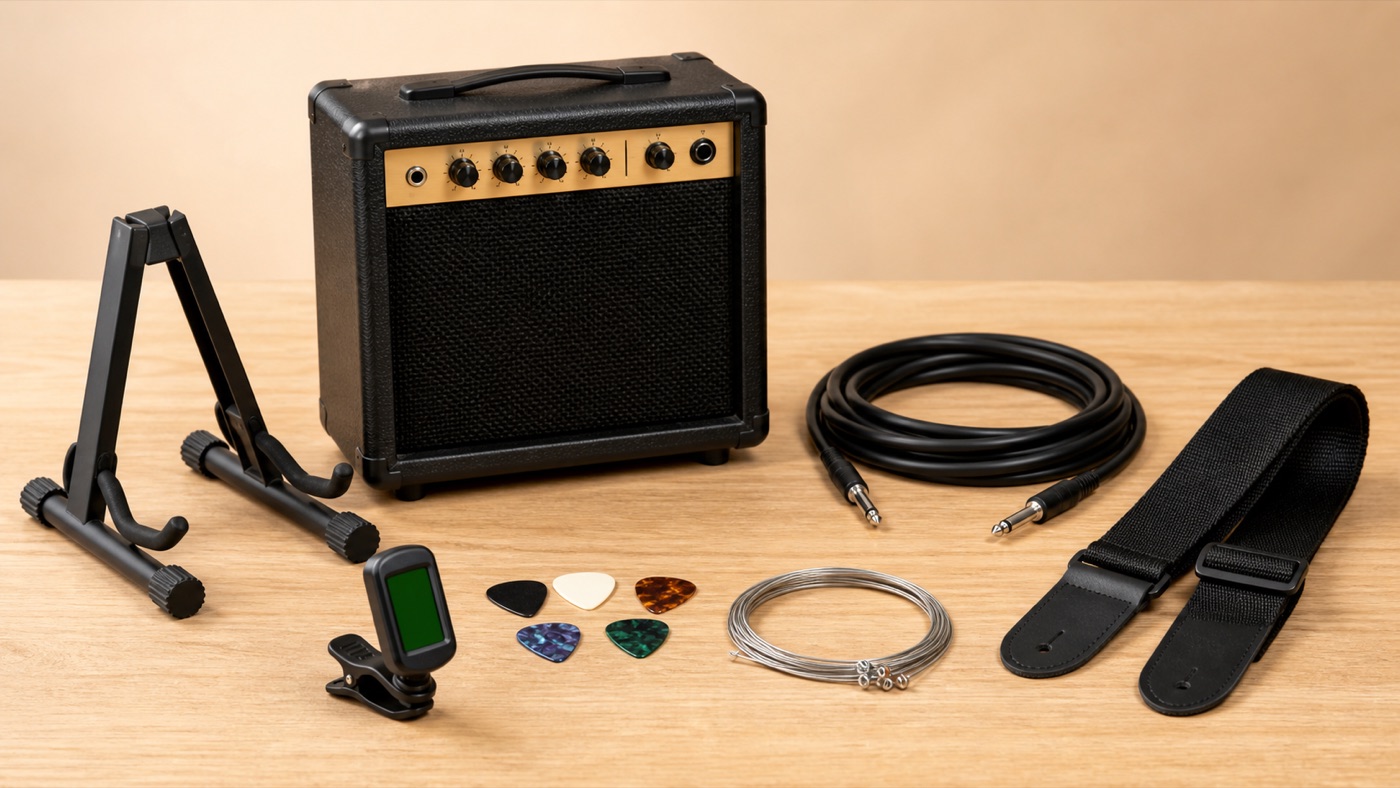
With your first electric guitar, buy a tuner, picks, spare strings, a cable, a strap, a stand, and a small practice amp. That is enough to start playing without wasting money on gear you do not understand yet.
Affiliate disclosure: this post includes Amazon.ca affiliate links. If you buy through them, GuitarTech may earn a commission at no extra cost to you.
Spare strings are not exciting, but they are one of the first things a beginner should own.
If a string breaks and you have no replacement, practice stops. If the strings are old, the guitar can feel dull and harder to tune. A fresh set is cheap insurance.
A practical beginner guitar kit: tune faster, keep spare strings ready, and make daily practice easier.
Affiliate disclosure: this guide includes Amazon.ca affiliate links. If you buy through them, GuitarTech may earn a commission at no extra cost to you.
Fastest beginner buy path
If the guitar is already picked, buy the friction-removers first: tune it, plug it in, keep it visible, and have spare strings ready.
If you are starting guitar in Canada, do not buy a pile of random accessories. Buy the few things that make the guitar easier to tune, easier to hold, easier to plug in, and easier to practice.
Skip pedalboards, expensive cables, boutique picks, complicated multi-effects units, and repair tools you do not know how to use yet. The first job is not building a studio. The first job is making daily practice easier.
Best first purchase if you already own a guitar and amp: a clip-on tuner, strings, picks, and a stand. That small kit removes the most common beginner friction.
Affiliate disclosure: this post includes Amazon.ca affiliate links. If you buy through them, GuitarTech may earn a commission at no extra cost to you.
A clip-on tuner is one of the cheapest pieces of gear that makes practice feel less frustrating.
For a beginner, the main advantage is speed. You clip it to the headstock, tune before you play, and avoid practicing on a guitar that sounds wrong before your hands even get a chance. That matters more than people admit.
What to look for: a bright display, simple chromatic mode, stable tracking, and a hinge that does not feel fragile. You do not need a complicated tuner. You need one that is visible, fast, and easy to use every day.
Buy the simple one first. If you later build a pedalboard, a pedal tuner can make sense, but a clip-on tuner is still useful as a backup, travel tool, or quick couch-practice fix.